If you or someone else shows one or more signs of stroke, call 911 immediately.

Stroke Center
Emergency Information
Specialized, Lifesaving Stroke Care
From the first sign of stroke to recovery, you want the right care. At Emory Healthcare, we manage strokes every day. This means you get the highest level of expertise at every stage of treatment.
Know the Signs of a Stroke
Every second counts when it comes to caring for someone with stroke symptoms. Teach yourself and your family to spot the signs of a stroke and call 911 immediately.
Time is brain. The faster a stroke is treated, the more likely a patient is to avoid complications.
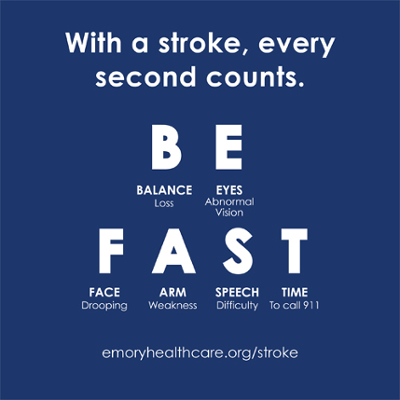
Watch Emory Healthcare stroke experts talk about how to recognize the signs and symptoms of a stroke.
Comprehensive Care from Stroke Experts
Our full-service stroke program provides exceptional care that only an academic medical center like Emory Healthcare can provide.
Our comprehensive and primary stroke centers provide the rapid response you need. All centers are certified by the American Heart Association/American Stroke Association and The Joint Commission.
Lifestyle, environment and genes all affect your risk for stroke. Emory Healthcare’s stroke teams combine varied expertise in different areas of stroke care. You get a level of care you won't find at other hospitals, because stroke care is what we do, day in and day out.
Stroke Center Locations
You get the most advanced care at Emory Stroke Centers. Our dedicated stroke teams and fully equipped emergency departments give you a fast diagnosis and treatment.
Each of our emergency departments provide 24/7 neurology coverage and access to a multidisciplinary medical stroke team when you need it.
Comprehensive Stroke Center Locations
Emory University Hospital
1365 Clifton Road
Atlanta, GA 30322
View Map
Primary Stroke Centers
Emory Decatur Hospital
2701 N Decatur Road
Decatur, GA 30033
View Map
Emory Johns Creek Hospital
6325 Hospital Parkway
Johns Creek, GA 30097
View Map
Emory Saint Joseph's Hospital
5665 Peachtree Dunwoody Road
Atlanta, GA 30342
View Map
Emory University Hospital Midtown
550 Peachtree St. NE
Atlanta, GA 30308
View Map
Our Stroke Services
Emory Healthcare provides multiple services to prevent and treat any kind of stroke or stroke complication. Our offerings include:
- Diagnostic Services
- Emergency Services
- Nervous System Disease Care
- Preventive Education and Treatment
- Rehabilitation Services
- Therapy Services
Tiffany’s Stroke Story
Tiffany was a healthy 44-year-old wife and mother when she had a stroke. With the help of Fadi Nahab, MD, a team of multispecialty providers and the right treatment plan through Emory Stroke Center, Tiffany is back to living a healthy life with her family.
Watch Tiffany’s story.
Call 911
If you or someone else shows one or more signs of stroke, call 9-1-1 immediately.
Make an Appointment with Emory Stroke Center
To make an appointment, please call 404-778-3444.
To talk with our stroke nurses, please call 404-737-2959.
MyChart Patient Portal
The MyChart Patient Portal gives you online access to your medical record and is easy to use. SignUp for MyChart Log Into MyChartMake an Appointment
To make an appointment, please call 404-778-3444.
To talk with our stroke nurses, please call 404-737-2959.
Research & Innovation