
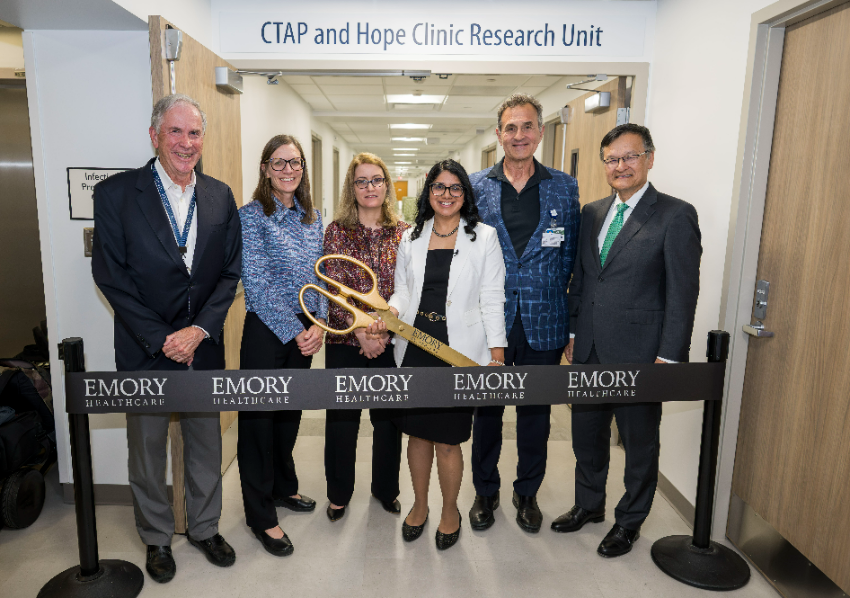
the center for transmission of airborne pathogens clinic is the first of its kind in the United States
The Emory Center for Transmission of Airborne Pathogens (CTAP) and Hope Clinic Research Unit is the first of its kind in the United States.

Photo by: Daniel Varnado, Emory Healthcare
ATLANTA -  The Emory Center for Transmission of Airborne Pathogens, in collaboration with Emory Hope Clinic, is establishing a dedicated research unit within Emory University Hospital to transform how airborne infectious diseases are studied.  A ribbon cutting was held on May 19 in preparation for the opening of the new unit, the only one of its kind in the U.S. studying human-to-human infectious transmission indoors.


Supported by a $10 million philanthropic investment from Flu Lab, an organization founded to advance innovative approaches for the prevention and treatment of influenza, this new space seamlessly integrates clinical care and research to directly measure how viruses spread through the air. 


As national leaders in infectious disease research and care, the Emory Center for Transmission of Airborne Pathogens unit marks a significant milestone in advancing controlled human infection studies and transmission science. The custom-designed unit features a 10-bed human challenge unit where study participants volunteer to enroll in human infection transmission studies involving airborne infectious diseases, including influenza, RSV, and other viruses. The unit also contains two dedicated exposure rooms with temperature and humidity controls, a clean room for aerosol sampling and an on-site virology laboratory. 


“This specialized unit has unique environmental systems to allow precise control of temperature and humidity—critical factors that influence airborne transmission—but have historically been difficult to study in human settings,” says Seema Lakdawala, PhD, co-director of the Emory Center for Transmission of Airborne Pathogens and associate professor in the Department of Microbiology and Immunology, Emory University School of Medicine. “By combining these capabilities, the unit enables researchers to capture concrete data on how infectious viruses are transmitted human-to-human and develop practical interventions to reduce the spread of respiratory pathogens and make indoor spaces safer.”

 
During the studies, which can last eight to 14 days, participants are admitted to the Emory Center for Transmission of Airborne Pathogens, where they undergo controlled transmission studies in a safely designed manner. They stay in spacious, airborne infection isolation rooms (AIIRs) through the duration of the study while being closely monitored. The rooms include a hospitality area complete with microwave and coffee machine to ensure a relaxing stay. Volunteers participate in a wide range of exposure and air sampling sessions while in the unit. At the end of each study, the research team will follow the study participants for several months after their hospital stay to capture information on immune responses to infection. 
 
“At the Emory Hope Clinic, the clinical arm of the Emory Vaccine Center, we provide the expertise and infrastructure to safely conduct these human infection studies, ensuring the highest standards of participant care and regulatory oversight,” says Nadine Rouphael, MD, executive director of Emory Hope Clinic and the Sumner E. Thompson, III Distinguished Professor of Vaccinology and Infectious Diseases at Emory. “The new unit positions Emory at the forefront of global efforts to understand and mitigate airborne disease transmission.”
 
The Emory Center for Transmission of Airborne Pathogens research unit, supported by the Emory Hope Clinic, is designed to conduct science today for healthier tomorrows. 

Subscribe to our newsletter

Register to receive our newsletter, Emory Healthcare Pulse, and stay up-to-date on the latest news, events, information and more from Emory Healthcare. Subscribe Now


Related News

  • emory healthcare's dr aneesh mehta at hantavirus news conference
    Working in coordination with local, state and federal collaborators, Emory University Hospital’s Serious Communicable Diseases Unit has received two passengers from the MV Hondius cruise ship following a hantavirus outbreak onboard.
  • woman receiving mammogram
    A new study published in the European Heart Journal has found that analyzing mammograms with artificial intelligence or AI can lead to better detection of cardiovascular disease in women, the leading cause of death in the U.S.
  •  Emory Healthcare offers organ donor registration through MyChart
    With more than 100,000 people on the national transplant waiting list, Emory Healthcare continues to expand options for potential organ donors with a few digital clicks. It now leads all Georgia health care systems in MyChart organ donor registrations, with more than 2,000 to date. 
Media Contact
Janet Christenbury
Emory Healthcare Media Relations
janet.christenbury@emoryhealthcare.org

Resources

Recent News


Emory University Hospital research unit studies the spread of airborne infectious diseases through human challenges

Date: May 20, 2026