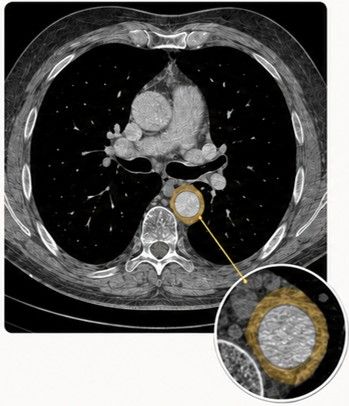

ATLANTA – Researchers at Emory University’s Empathetic AI for Health Institute have developed a new imaging biomarker that uses AI to tell a person what their cardiovascular age is by analyzing the fat surrounding their aorta.
Mendel Lebowitz, a current MD/PhD candidate at Emory School of Medicine and Anant Madabhushi, PhD, executive director of Emory University’s Empathetic AI for Health Institute, recently co-authored a study based on this tool and published their work in the European Heart Journal, the leading cardiology journal, worldwide.
“The aorta is the body’s largest blood vessel and carries blood from the heart to the rest of the body. We wanted to see whether the fat surrounding it could tell us something about how a person’s heart and blood vessels are aging,” says Lebowitz. “By looking for subtle patterns in that fat on routine CT scans, we may be able to identify people whose cardiovascular system appears older — or younger — than their actual age.”
The study assessed 48,000 routine chest CT scans from four different health institutions, including Emory, using their AI cardiovascular aging tool. They utilized advanced imaging analysis to extract detailed features from this fat surrounding the aorta, including its volume, density and texture. The AI-driven tool was then able to estimate the true cardiovascular age of a person based on the biomarker’s algorithms. This number often differs from a person’s chronological age and can determine their potential cardiovascular risks.
“We found that this fat around the aorta clearly predicts cardiovascular outcomes. Someone can have a low-risk profile, but it may not be the full picture for them. With this tool, people can get a better understanding of their heart health and be empowered to get intervention if needed,” says Madabhushi, who is also a professor in the Wallace H. Coulter Department of Biomedical Engineering at Emory University School of Medicine and Georgia Tech.