
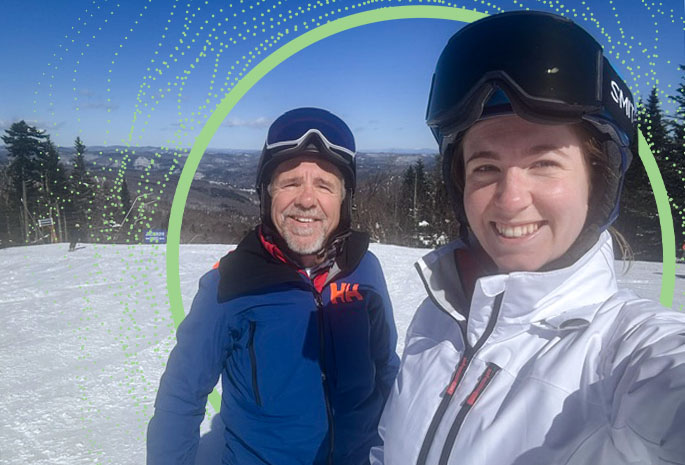
'Pure Joy': Mark's Return to Skiing 

By: Mary Loftus
Date: Jun 9, 2026

Knee replacement surgery is often thought of as a “last resort,” reserved for older adults willing to give up active lifestyles in exchange for less pain.

But advances in orthopaedic technology, surgical precision and personalized recovery are helping patients return to the activities they love with greater confidence and mobility. From hiking and pickleball to skiing and tennis, patients are rediscovering what’s possible after knee replacement.

For Mark, a 70-year-old retired pilot and avid skier, the decision to move forward with knee replacement surgery came down to one activity he could no longer enjoy.

“I knew it would be impossible for me to ski if I didn’t have my knee worked on,” Mark says. “The pain was consuming. At its worst, it was a nine out of 10. You can’t think about anything else.”

Today, after total knee replacement surgery at Emory Orthopaedics & Spine Center, he’s back on the mountain.

Cancer Care

Leading orthopaedic and sports medicine treatments

Learn about Emory Orthopaedics & Spine care. Make an appointment online, find a provider or call 404-778-3350 to schedule an appointment.

“This year was pure joy. Making turns with no pain — it was wonderful. My knee felt great.”

When knee pain starts limiting life

Mark spent years pushing through, staying active despite increasing knee pain. He played pickleball and tennis but gradually noticed his movement slowing down. Skiing, the activity he loves most, became the clearest sign that something had to change.

“What I love about skiing is the flow of it. It’s athletic, dynamic and mentally engaging,” he says. “But I got to where I could only ski about half a day and then I was done."

Like many patients, Mark initially hoped to delay surgery.

That hesitation is common, according to Ajay Premkumar, MD, orthopaedic surgeon.

“In the past, knee replacement was often considered a last-resort surgery for patients later in life,” Dr. Premkumar says. “Now, we’re seeing younger patients seek out knee replacement earlier to maintain their active lifestyles, especially people under 65.”

The most common reason for surgery is advanced arthritis, often called “bone-on-bone” arthritis, where the cartilage cushioning the knee has worn away completely.

Symptoms can include:

  • pain with walking or climbing stairs
  • trouble sleeping because of knee pain
  • difficulty exercising or staying active
  • loss of quality of life during everyday activities

“If knee pain or instability limits how you live on a daily basis, it may be time to consider treatment options.”

Trying conservative treatments first

Most patients begin with non-surgical approaches before considering surgery. These may include:

  • physical therapy
  • anti-inflammatory medications
  • steroid injections
  • other therapies designed to reduce inflammation and improve function

Mark did exactly that. He tried cortisone shots but they were ineffective. And after a ski injury that caused sudden, severe pain, he spent nearly a year in physical therapy strengthening his knee.

“I’m actually somebody who enjoys PT,” he says. “I like understanding how the body works and feeling like I’m doing something productive.”

Despite the treatments, Mark’s symptoms progressed.

“The next ski season, I could feel pain every time I turned,” he says. “That’s when I knew: I’m done. I need to address this.”

Dr. Premkumar says conservative, non-surgical treatments can help manage symptoms and in many patients can help them participate in the activities they enjoy, but ultimately thus far these measures have not been shown to reverse the underlying arthritis that has already progressed.

“To date, these treatments can reduce pain and inflammation which can have dramatic improvements to quality of life,” he says. “But the underlying issue — the loss of cartilage in cases of severe arthritis — doesn’t change.”

A personalized approach to surgery

At Emory Healthcare, knee replacement surgery is highly individualized. Surgeons evaluate not only imaging and arthritis severity, but also each patient’s goals, activity level and lifestyle.

“Every patient has different priorities,” Dr. Premkumar says. “The decision should be shared between the patient and surgeon. Our job is to guide and inform, not make the decision for them.”

A partial knee replacement may be an option, if arthritis affects only one part of the knee. Others benefit from a total knee replacement, if damage is more widespread.

Mark, who only needed to have one knee replaced, appreciated the collaborative approach throughout his care. “Dr. Premkumar was very clear about what he was doing and what to expect,” he says. “I felt comfortable the whole time.”

Mark had also done his homework. One of his longtime ski friends is an orthopaedic surgeon specializing in knees and encouraged him to consider robotic-assisted technology and contemporary implant systems.

That technology is changing how knee replacements are performed.

“Every patient has different priorities. The decision should be shared between the patient and surgeon.”

How technology is improving knee replacement

Today’s knee replacement procedures are far more precise than they were even 10 years ago.

“At Emory, we’re using cutting-edge technology to better understand gait patterns, alignment and movement,” Dr. Premkumar says. “That helps us personalize surgery for each patient.”

Advances include:

  • muscle-sparing and minimally invasive techniques
  • 3D and dynamic imaging to improve surgical planning
  • computer-guided and robotic-assisted technology
  • improved implant materials and durability
  • enhanced recovery and pain-management protocols

Robotic-assisted and computer-guided systems can help surgeons fine-tune alignment and ligament balance during surgery. “These technologies help improve precision and consistency,” Dr. Premkumar says. “The goal of modern knee replacement is to help create an environment where the knee feels stable and natural during movement.”

“The ultimate goal is helping patients return to their highest level of function possible.”

Recovery: Challenging, but worth it

While many patients recover from knee replacement surgery faster than in the past, healing still requires dedication and patience.

Improved pain management, minimally invasive approaches and better rehabilitation protocols have all helped speed recovery.

Still, Mark says the early weeks after surgery were difficult. “I was surprised by how painful it was for about a month,” he says. “I used all my pain medication. I was taking tiny steps.”

He decided to focus on the fact that surgery had been a choice for long-term gain, even if there was short-term pain. That mindset became an important part of his recovery. “This is a big procedure, but I kept reminding myself: I’m not sick. I’m recovering,” Mark says. “The bright side was that I could feel improvement almost every day.”

Dr. Premkumar says Emory’s orthopaedic teams prioritize helping patients control swelling, restore movement and safely regain strength. “We focus on a ‘quiet knee’ approach,” he says. “That means reducing inflammation and allowing the body to heal as efficiently as possible.”

“Most patients now go home the same day as surgery. Recovery today is very different than it was a decade ago.”

Returning to what matters most

One of the most exciting developments in knee replacement is how natural modern implants can feel. “One measure we look at is called the ‘Forgotten Joint Score,’” Dr. Premkumar says. “It reflects how often patients even remember they had surgery.” At Emory, we are on the leading edge of studying and developing strategies to improve how each joint replacement feels so more patients can achieve a "forgotten joint."

Today’s implants are designed to move more naturally while lasting longer than previous generations. Modern studies suggest that more than 90% of knee replacements are still functioning after 20 years.

For Dr. Premkumar, stories like Mark’s are the most rewarding part of orthopaedic care. “The best part is being a participant on the journey to help people get back to the activities and events they enjoy after surgery,” he says.

Mark recently sent Dr. Premkumar a video of him skiing at Crested Butte, Colorado.

“You’re killing it!” the doctor texted back.

About Emory Orthopaedics & Spine Center

Emory Orthopaedics & Spine offers comprehensive orthopedic and spine care at multiple locations across the Atlanta metro area, and our orthopedic and spine programs are ranked among the top in the nation. Our highly trained orthopaedic and spine specialists work together to diagnose and treat a wide variety of orthopaedic, spine, and sports medicine conditions.

Our physicians use innovative approaches to care – many of them pioneered right here at Emory – to ease your pain and get you back to an active lifestyle.

Emory University Orthopaedics & Spine also has among the highest patient satisfaction and best outcome rates in the nation* for your surgery. By using advanced research techniques developed by our top surgeons, we can make sure your surgery is done right the first time.

*Results based on an average of 86% patient satisfaction rating compared to a national benchmark of similar facilities at 68%. Infection rates averages at .45% for primary hip and knee procedures compared to .58% nationally.


Related Posts

  • Doctor and female patient
    Learn how ACL (anterior cruciate ligament) tears happen, who’s most at risk, and the best ways to treat and prevent this common knee injury.
  • monica pearson smiling
    Atlanta icon Monica Pearson conquered knee pain and reclaimed her active life after robotic-assisted partial knee replacement at Emory Healthcare.
  • College student Hanbi
    College student Hanbi found relief from chronic back and leg pain with minimally invasive spine surgery at Emory Healthcare. After years of failed treatments, endoscopic surgery quickly relieved her symptoms and helped her return to school, sports and everyday life.

Emory Healthcare Pulse

For more stories and health and wellness tips, sign up for our monthly newsletter.


Sign Up


Recent Posts