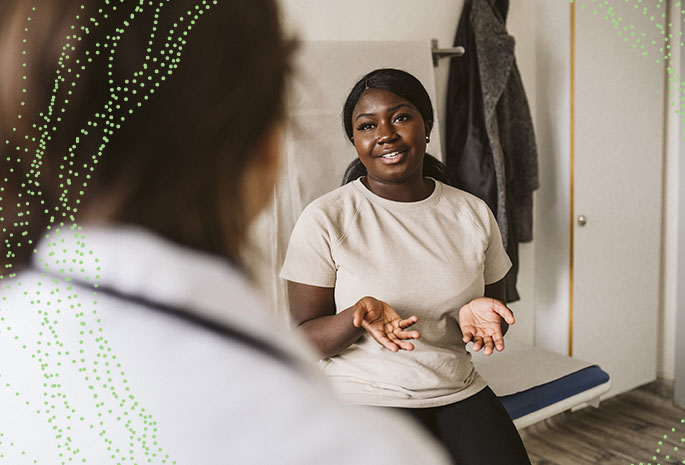
Fighting Fibroids: Ameerah Shares “The Only Thing That Worked”

By: Allison Milionis
Date: May 8, 2025

Ameerah has faced more than her share of challenges—from surviving Hurricane Katrina to rebuilding her life in Atlanta. But nothing prepared her for the toll fibroids would take on her body and her daily life.

Several years ago, Ameerah, 47, began to have intense cramps, migraines and heavy bleeding during her menstrual cycle. “I didn’t know what was wrong,” says Ameerah.

The pain disrupted her work and strained her relationships. A visit to the doctor, followed by a pelvic exam and ultrasound, revealed the cause: fibroids. 

Pulse

Supporting women’s health at every stage

Our gynecologists understand that a woman’s health needs change over time. We’ll meet you wherever you are and help you get where you want to be. Find a provider who can support you through each stage of life.

How Fibroids Affect Women's Well-being—And Quality of Life

Uterine fibroids are noncancerous growths that develop in or on the uterus. They’re especially common during a woman’s reproductive years. Doctors don’t know what causes them, but genetics, as well as hormones like estrogen and progesterone, are believed to play a role.

“Fibroids grow from a single muscle cell into hard, small-to-large tumors,” says Cherie Hill, MD, an obstetrician and gynecologist with Emory Healthcare. Dr. Hill is also an assistant professor in the Department of Gynecology and Obstetrics at Emory University School of Medicine.

The good news? Fibroids aren’t cancer and rarely interfere with pregnancy. They grow very slowly or not at all.

Many women may not experience any symptoms and can comfortably live with fibroids, which can shrink after menopause. For women who experience no symptoms, they may be diagnosed with fibroids during routine pelvic exams at annual well-women’s exams with their gynecologist. An ultrasound can then support care teams in confirming the diagnosis and measuring the fibroids to inform treatment.

The bad news? As fibroids grow, they can press against nearby organs. Some push on the bladder and cause frequent urination or a constant feeling of pressure. Others can press against the vagina, causing pain during intercourse. These symptoms of fibroids are a sign to schedule an appointment with your gynecologist.

Many treatment options exist for uterine fibroids, from monitoring them if there are no symptoms, to medication to attempt to shrink them, to varying surgical options. 

The good news? Fibroids aren't cancer and rarely interfere with pregnancy. The bad news? As fibroids grow, they can press against nearby organs. If you're experiencing symptoms, it's time to schedule an appointment with your gynecologist.

A Minimally-Invasive Approach Brings Relief 

Ameerah’s ultrasound revealed three fibroids. Two were the size of grapes, and one was the size of a plum.

To treat Ameerah’s fibroids, Dr. Hill performed a procedure that uses heat to shrink or break up fibroids and soften the tissue over time. The procedure, called radiofrequency ablation, is a minimally invasive approach often performed in an outpatient setting.

“During a radiofrequency ablation, we make two small incisions in the abdomen while the patient is under anesthesia,” says Dr. Hill. “Then we use a skinny camera to place a small probe directly into the fibroid, where we apply controlled heat.”

Because it’s minimally invasive, the procedure has less pain, fewer risks and a quicker recovery. Most patients can go home the same day as their procedure.

The minimally invasive gynecologic surgery team at Emory Healthcare treats fibroids and many other complex conditions, including endometriosis and pelvic floor disorders. Dr. Hill performs radiofrequency ablation at Emory University Hospital Midtown. Stephen H. Weiss, MD, offers the procedure at Emory University Hospital.  

“The changes happened immediately. I tried everything and nothing worked before this surgery." -Ameerah, patient  

Pain-free Without Major Surgery 

One treatment option for fibroids is a hysterectomy—or the removal of the uterus. It’s a definitive solution, as it completely eliminates fibroids and any future growth, and can be considered when other treatments have been ineffective or when symptoms are severe.

Dr. Hill says treating fibroids with radiofrequency ablation is an excellent option for patients who experience pain and heavy bleeding but want to keep their uterus. Radiofrequency ablation offers relief from symptoms, while preserving a woman’s ability to have children. For many patients, keeping the uterus is important for personal, emotional or reproductive reasons.

The U.S. Food and Drug Administration (FDA) has not yet approved the procedure for pregnant women. Currently, it is not recommended for women who want to get pregnant.

Dr. Hill recommends a traditional myomectomy for women who plan to get pregnant. A myomectomy is a surgical procedure to remove fibroids through several incisions in the abdomen. This approach preserves the uterus, but recovery takes four to six weeks. 

The Only Thing That Worked—Thriving After Surgery 

Most patients notice a significant decrease in heavy bleeding following radiofrequency ablation. Dr. Hill says most patients can return to their normal routines within one to two weeks. Many women experience a dramatic reduction in pain in three to six months.

For Ameerah, the results were almost instant. “The changes happened immediately. I tried everything and nothing worked before this surgery,” she says. “I let Dr. Hill lead. It was the best decision I ever made.”

After facing some tough chapters in life, Ameerah now embraces brighter, healthier and pain-free days. She is grateful for the treatment that gave her relief and an opportunity to thrive.

Learn more about the minimally invasive surgical procedures with Emory Healthcare's gynecology team and call 404-778-3401 for more information.  

Supporting women’s health at every stage

Women's Health Services at Emory Healthcare provides comprehensive, personalized care designed around you and your health goals. Whether you're seeking preventive care, fertility support, pregnancy care, menopause management or specialized gynecologic services, our experienced team is here to guide you through every stage of life. With nationally recognized specialists, coordinated care and the latest evidence-based medicine, we're committed to helping you achieve your healthiest life.

Related Posts

  • Motorcycle racer Giacomo came to Emory Healthcare for an ACL tear
    Professional motorcycle racer Giacomo raced for two years with a torn ACL. When the injury worsened, he turned to Emory for expert ACL care and a fast recovery.
  • female patient chats with doctor
    An annual well-woman visit with an OB-GYN focuses on whole-person health, including screenings, reproductive care, menopause, and changes across every life stage.
  • womenswellexam2000x1333
    Women’s wellness is more than a Pap test. A women's well exam is a chance to connect with your provider to discuss any concerns and prevent future issues.

Emory Healthcare Pulse

For more stories and health and wellness tips, sign up for our monthly newsletter.


Sign Up


Recent Posts